




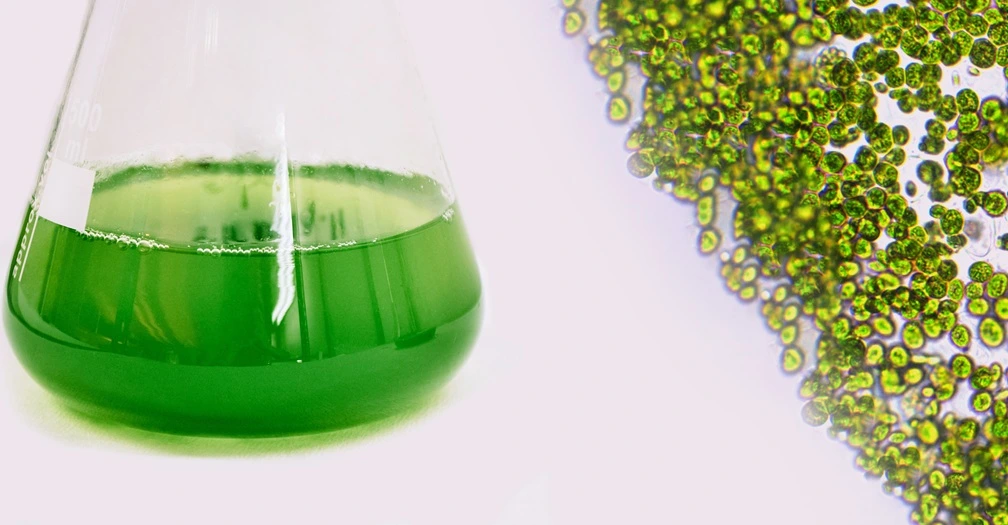
When choosing a chlorella product, it is easy to focus on what appears on the label. But the story of chlorella begins much earlier, while the microalga itself is still growing.
Chlorella is a living organism, and producing it involves more than simply growing large quantities of green microalgae. The species and strain selected, the environment in which it grows, access to sunlight and water, and the way it is processed after cultivation can all be relevant when looking at how a chlorella product is produced.
So, does the way chlorella is grown matter? Yes. Looking at how chlorella is cultivated and processed can tell us much more about a product than the word “chlorella” on the label alone.
Not All Chlorella Starts the Same
The word “chlorella” does not refer to one completely uniform ingredient. There are different species and strains of chlorella, and these can have different characteristics and nutritional compositions.
This means that chlorella production begins with an important decision: which chlorella will actually be cultivated. Producers can select strains according to characteristics such as how well they grow under particular production conditions and the nutritional profile they are seeking.
As a result, two products may both list chlorella as an ingredient without necessarily starting from exactly the same type of chlorella.
Why Does the Growing Environment Matter?
Once a strain has been selected, it needs suitable conditions in which to grow. As a photosynthetic microalga, chlorella interacts directly with its surrounding environment during cultivation.
Factors such as sunlight, water, temperature and overall growing conditions therefore form part of the production process. Maintaining suitable conditions also helps producers cultivate chlorella consistently rather than leaving its growth entirely to environmental variation.
This is one reason the production process matters when comparing chlorella products. The finished tablet or powder may look simple, but producing the chlorella inside it begins with creating and managing an appropriate environment for a living microalga.
Why Is Sunlight Important for Chlorella?
Chlorella uses light energy for photosynthesis, the biological process through which photosynthetic organisms use light to support their growth. Sunlight is therefore closely connected with the way chlorella grows.
However, chlorella can be produced using different cultivation systems. Some production methods use outdoor environments with natural sunlight, while others may use more enclosed or controlled cultivation systems.
This doesn’t mean that one cultivation method should automatically be considered better simply because it takes place outdoors. Instead, it highlights an important point: how chlorella receives light and the conditions under which it grows are deliberate parts of the cultivation process.
Growing Chlorella Is Only the Beginning
Cultivation is important, but it isn’t the end of the story. Once chlorella has been grown and harvested, it still needs to be processed into a form suitable for consumption.
This is particularly relevant because chlorella naturally has a tough cell wall. That structure has helped the microalga survive environmental changes, but it also means that processing methods deserve attention when evaluating a chlorella product.
The way manufacturers address the cell wall can therefore become another point of difference between products. This moves the question of quality beyond simply “How was the chlorella grown?” to another important question: “What happened to it after it was grown?”
Why Does Chlorella’s Cell Wall Matter?
Many of chlorella’s naturally occurring components are contained within its cells. For this reason, manufacturers may use processing techniques designed to disrupt or pulverize the cell wall and make the contents of those cells more accessible during digestion.
The method used matters. Different producers may use different technologies and processes, so cell-wall treatment is another useful factor to investigate when comparing chlorella products.
Cultivation and processing should therefore not be viewed as completely separate questions. They are different stages of the same journey from a living microalga to the chlorella people ultimately consume.
What Happens After Cultivation Matters Too
Even after cultivation and cell-wall processing, there are still several stages before chlorella becomes a finished product. Raw-material management, manufacturing conditions, quality checks and safety controls all form part of that process.
This is why quality cannot be judged by appearance alone. A dark green tablet or powder doesn’t tell you how its raw material was managed, how consistently it was manufactured or what quality-control systems were used.
Looking at the entire production process provides a more useful picture than relying on any single characteristic.
What Should You Look for When Choosing Chlorella?
A chlorella ingredient list can be surprisingly simple, but the process behind that ingredient may not be. If you want to understand how a chlorella product has been produced, there are several useful questions to consider.
You can look at which species or strain is used, how the chlorella is cultivated, which environmental conditions are prioritized, how the cell wall is processed, and what manufacturing and quality-control systems are in place.
No single factor automatically defines a high-quality chlorella product. Looking at these factors together, however, provides much more information than judging chlorella solely by its color, form or the number of tablets in a package.
How Does Sun Chlorella Approach Chlorella Quality?
At Sun Chlorella, these considerations are incorporated at different stages of production, beginning with the chlorella itself.
Strain selection: Sun Chlorella studied different chlorella strains to identify one suited to its production conditions and desired nutritional characteristics. This led to the selection of a strain of Chlorella pyrenoidosa used in Sun Chlorella products.
Outdoor cultivation: Sun Chlorella has chosen outdoor cultivation, allowing its chlorella to receive abundant natural sunlight. Its production approach prioritizes conditions including sufficient sunlight, stable temperatures, pure water and clean air. Sun Chlorella’s production research has also found differences between its outdoor cultivation method and tank cultivation without sunlight in components including vitamin B12 and Chlorella Growth Factor (CGF).
Cell-wall processing: After cultivation, Sun Chlorella uses a physical cell-wall pulverization process. According to the company’s production data, this technology pulverizes more than 90% of the chlorella cell wall without using unnecessary chemicals or enzymes in the process, with the aim of improving digestibility while preserving useful naturally occurring components.
Manufacturing and quality control: Quality management continues after the raw chlorella has been processed. Sun Chlorella A is manufactured in a GMP-certified facility, and Sun Chlorella has also obtained certifications and third-party assessments through the Japan Health and Nutrition Food Association (JHFA).
Taken together, these steps reflect an approach in which quality is considered throughout production rather than being checked only once the finished product has been made.
Final Thoughts
Two products can both say “chlorella” on the label while having very different stories behind them. Species and strain selection, growing conditions, access to light and water, cell-wall processing, manufacturing and quality controls can all form part of that story.
Understanding these factors makes it easier to look beyond the front of the package and ask more useful questions about how a chlorella product was actually produced.
Quality doesn’t begin when chlorella becomes a tablet or powder. It begins with how the chlorella itself is grown.