




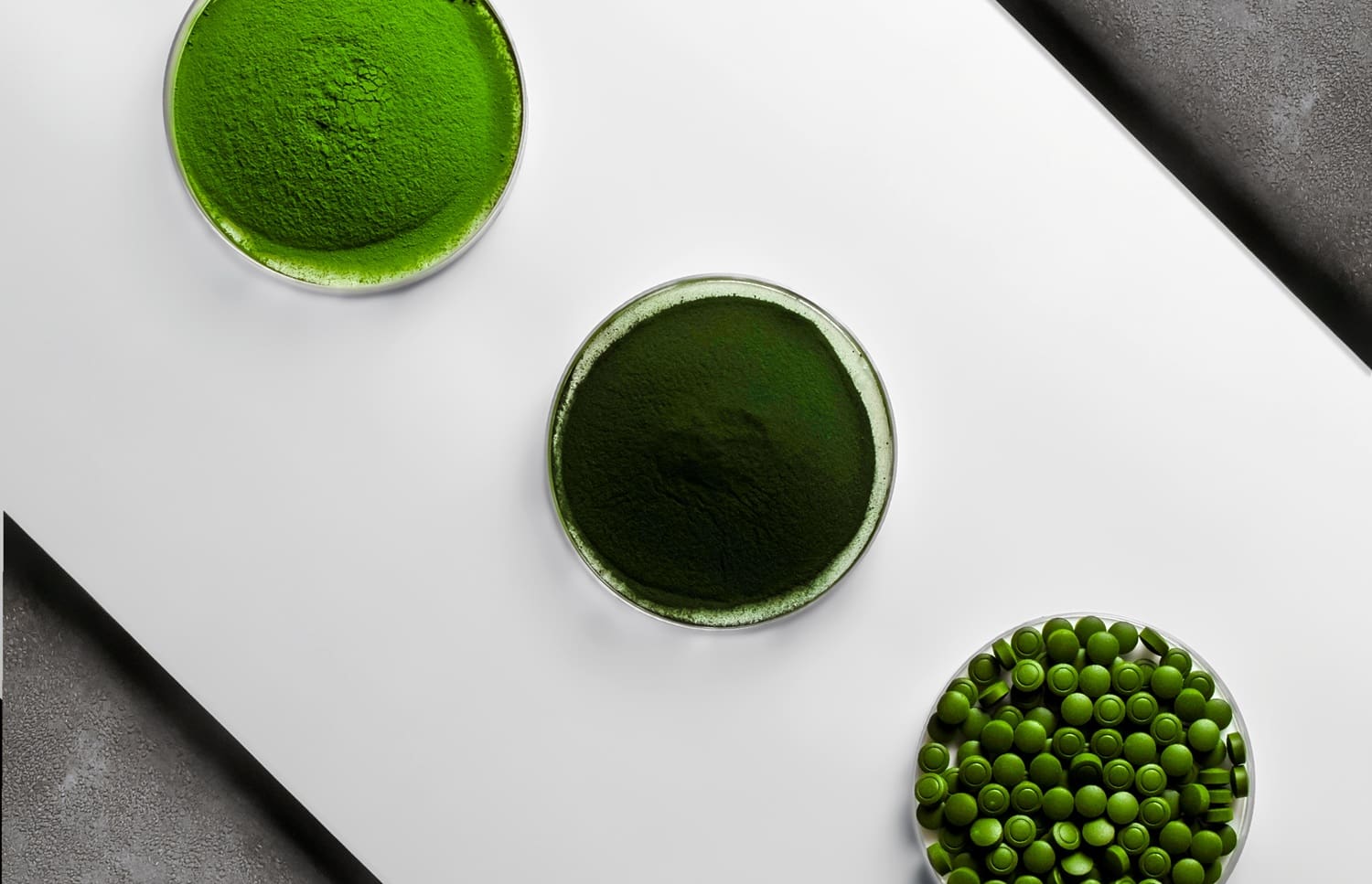
Chlorella is commonly sold alongside vitamins, minerals and other dietary supplements. It often comes as tablets or powder, and people typically add it to their daily nutritional routine. So it seems natural to think of chlorella simply as another supplement.
But there is an important difference. Chlorella isn’t a formula created by combining a selection of isolated nutrients. It is a microscopic freshwater microalga with its own naturally occurring nutritional composition.
This means chlorella can be understood as a whole-food ingredient that is commonly consumed in supplement form. Understanding that distinction can also help explain why chlorella is different from products such as conventional multivitamins.
What Do We Mean by a Whole Food?
The term “whole food” generally describes a food that remains relatively close to its original form rather than being broken down into individual nutrients and then reconstructed into a formula.
An apple, for example, doesn’t contain vitamin C because someone added vitamin C to it. Its vitamins, minerals, fiber, carbohydrates and naturally occurring plant compounds are all part of the food itself.
The same basic principle can be applied to chlorella. Its nutritional components originate within the microalga rather than being individually selected and combined to create a nutritional formula.
However, calling something a whole food doesn’t automatically mean that it is nutritionally superior to every other type of product. It simply helps us understand where its nutritional composition comes from.
So, Is Chlorella a Whole Food?
Chlorella is a single-celled green microalga. Although each cell is microscopic, the organism naturally contains a diverse range of nutritional components.
These include protein and amino acids, chlorophyll and other pigments, as well as various vitamins and minerals. Chlorella also contains naturally occurring compounds collectively known as Chlorella Growth Factor (CGF).
Importantly, these components aren’t individually added to chlorella during manufacturing. They are naturally present within the organism itself.
This is why chlorella can be described as a whole-food ingredient, even when it is eventually dried and prepared as a powder or pressed into tablets.
Why Is Chlorella Sold as a Dietary Supplement?
If chlorella is a whole-food ingredient, why do we usually find it in the supplement section rather than the produce aisle?
Part of the answer comes down to how it is consumed.
Fresh chlorella isn’t something most people buy and prepare like spinach, broccoli or other familiar green foods. Because chlorella cells are microscopic, the microalgae must first be cultivated and harvested before they can be processed into a practical form for consumption.
Powders and tablets make it possible to incorporate chlorella into an everyday nutritional routine in a consistent and convenient way.
In this sense, the two descriptions aren’t necessarily contradictory. “Whole-food ingredient” describes the nature of chlorella itself, while “dietary supplement” can describe the form and purpose in which it is offered to consumers.
How Is Chlorella Different from a Multivitamin?
The distinction becomes easier to understand when chlorella is compared with a conventional multivitamin.
A multivitamin is generally formulated by selecting particular vitamins and minerals and providing them in predetermined amounts. Depending on the formula, manufacturers may combine vitamin C, vitamin D, B vitamins, iron, zinc and other nutrients in a single product.
Chlorella works differently. Its nutritional profile isn’t designed by selecting individual nutrients. The protein, pigments, vitamins, minerals and other naturally occurring components are part of the microalga itself.
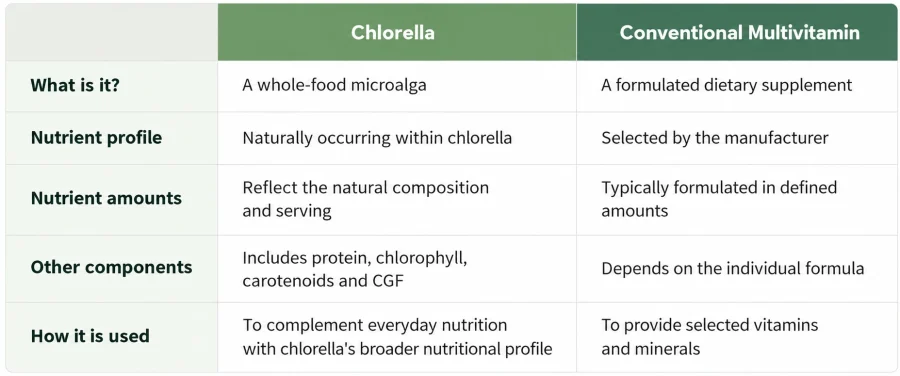
Neither approach is automatically better. They simply represent different ways of adding nutrients to a diet.
What Does Chlorella Naturally Contain?
One reason chlorella has attracted nutritional interest is that so many different components occur within such a small organism.
Chlorella naturally provides protein containing essential amino acids, along with pigments such as chlorophyll and carotenoids. It also contains a range of naturally occurring vitamins and minerals, although their amounts can vary and should always be considered in relation to the specific product and serving size.
Another characteristic component is Chlorella Growth Factor (CGF), a term used for naturally occurring compounds associated with chlorella cells.
Rather than viewing any one of these components as the reason to consume chlorella, it can be more useful to look at them as parts of its broader nutritional profile.
Does Processing Mean Chlorella Stops Being a Whole-Food Ingredient?
Processing is sometimes assumed to mean that a food is no longer “whole,” but the reality is more nuanced.
Chlorella needs to be cultivated, harvested and prepared before it can become a practical food ingredient. Processing can include steps such as drying and producing powder or tablets. Some chlorella products also use specialized methods to make the contents of the cells more accessible during digestion.
This is particularly relevant because chlorella naturally has a relatively tough cell wall. At Sun Chlorella, specialized processing technology is used to pulverize the chlorella cell wall while retaining the chlorella itself as the ingredient.
This is fundamentally different from extracting individual vitamins or minerals from chlorella and combining those isolated nutrients into a new formula. The objective is still to provide the nutritional components naturally present within the chlorella.
Does “Whole Food” Mean Better?
Not necessarily.
Whole foods offer complex combinations of nutrients and naturally occurring compounds, which is one reason they form the foundation of a varied diet. But there are also situations in which obtaining a specific nutrient in a clearly defined amount can be useful.
For example, someone who needs a particular nutrient may be advised to use a supplement specifically formulated to provide it. Chlorella shouldn’t be considered a substitute for every vitamin, mineral or other dietary supplement simply because it comes from a whole-food source.
The more useful question is not whether whole-food nutrition is universally “better,” but what nutritional role a particular food or supplement is intended to play.
Where Does Sun Chlorella Fit?
Sun Chlorella begins with chlorella as a whole microalga rather than constructing a nutritional formula from a collection of isolated vitamins and minerals.
Careful cultivation and processing are important parts of turning that microscopic organism into a product that can be consumed conveniently. Sun Chlorella uses specialized technology to process the chlorella cell wall, and the finished chlorella is available in formats such as tablets and powder.
These formats offer different ways to incorporate the same whole-food ingredient into everyday life. Tablets provide a convenient, measured format, while powder can be mixed into foods, drinks and recipes.
In either case, chlorella is intended to complement a varied and balanced diet, not replace one.
Final Thoughts
So, is chlorella a whole food or a supplement?
The most useful answer is that chlorella is a whole-food microalga that is commonly prepared and consumed in dietary supplement form.
Unlike a conventional multivitamin, its nutritional profile isn’t created by selecting individual vitamins and minerals and combining them into a formula. Protein, chlorophyll, carotenoids, vitamins, minerals, CGF and other components occur naturally within chlorella itself.
That doesn’t make chlorella automatically better than an isolated nutrient or a multivitamin. It simply makes it different.
And understanding that difference helps explain why those small green tablets contain much more than a collection of ingredients added together.