




As our understanding of biological aging advances, nutritional science has shifted its focus from simple longevity to “healthspan”—the period of life spent in good health, mental clarity, and physical independence. For adults in their 50s and 60s, maintaining cognitive agility, focus, and memory becomes a primary daily wellness priority.
While lifestyle habits like regular exercise, restful sleep, and continuous mental engagement form the foundation of neurological health, cellular nutrition plays a critical supporting role.
Among the specialized compounds studied for cognitive wellness, plasmalogens have emerged as a key area of focus in neurobiology.
Understanding what plasmalogens are, how their levels change over time, and how specialized marine nutrition can complement their function offers valuable insight into supporting long-term mental clarity.
What Are Plasmalogens?
To understand plasmalogens, imagine your brain cells as busy communication centers. Every brain cell is wrapped in a protective outer layer called a cell membrane. This membrane needs to be both flexible and strong so cells can send signals efficiently.
Plasmalogens are a specialized type of structural lipid (fat molecule) found naturally throughout the human body. They are particularly concentrated in areas that handle complex electrical and chemical signaling:
- The Brain and Nervous System: Representing a large portion of brain cell membrane lipids and myelin sheath structures.
- The Cardiovascular System: Supporting heart muscle tissue integrity.
- Immune Cells: Assisting in structural readiness and cellular communication.
In brain tissue, plasmalogens help maintain synaptic fluidity—the structural capability of neurons to pass messages back and forth smoothly.
Why Plasmalogen Levels Change with Age
In our younger years, the body produces plasmalogens efficiently to meet daily biological demands. However, as part of the natural aging process, this internal production naturally slows down.
Additionally, because plasmalogens contain delicate unsaturated fatty acids (such as DHA), they are especially vulnerable to oxidative stress. Everyday environmental factors and normal metabolic activity create free radicals that can deplete plasmalogen reserves over time.
When plasmalogen levels decline in cell membranes, it can impact:
- How smoothly brain cells transfer signals to one another.
- The membrane’s ability to protect itself against oxidative pressure.
- Overall daily mental focus, memory recall, and cognitive sharpness.
Replenishing these specialized structural lipids through targeted nutrition offers a proactive way to support mental clarity through active aging.
The Breakthrough: Marine-Sourced DHA Plasmalogens from Sea Pineapple
Not all plasmalogens in nature are identical. Research in Japan has focused on DHA-type plasmalogens derived from Sea Pineapple (Hoya), a marine organism naturally rich in these unique phospholipids.
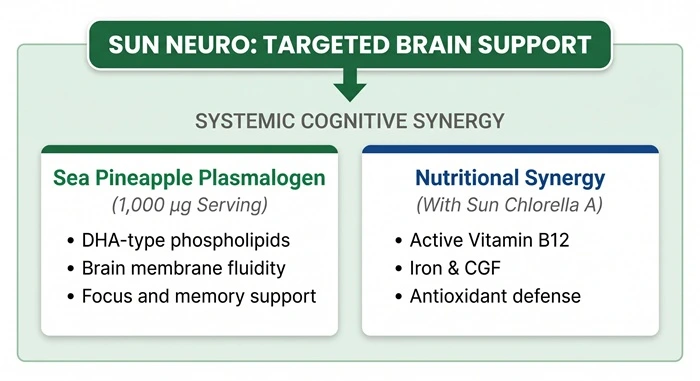
Developed through collaborative research involving Professor Emeritus Teruo Miyazawa of Tohoku University, Sun Chlorella’s specialized formula, Sun Neuro, utilizes a carefully controlled extraction process from dried sea pineapple powder.
This marine source delivers 1,000 µg of DHA-type plasmalogens per daily serving, providing a stable, consistent, and bioavailable format designed for daily cognitive support.
How Plasmalogens and Chlorella Work Together
While plasmalogens supply targeted structural lipids for brain cell membranes, maintaining overall neurological health requires a full spectrum of daily nutrients. Combining specialized plasmalogen support with a whole-food foundation like chlorella creates an ideal nutritional partnership:
1. Oxygenation and Nutrient Transport
The brain demands roughly 20% of the body’s daily oxygen supply. Sun Chlorella A naturally supplies active Vitamin B12 and bioavailable iron, which support normal red blood cell formation and efficient oxygen delivery to brain tissues.
2. Antioxidant Defense for Cell Membranes
Because plasmalogens are sensitive to oxidative breakdown, surrounding tissues benefit from antioxidant protection. Chlorella provides natural chlorophyll, carotenoids, and Chlorella Growth Factor (CGF) to help manage oxidative stress.
3. Structural Cell Maintenance
CGF delivers naturally occurring nucleic acids (RNA/DNA building blocks) and amino acids that support general cellular repair and maintenance alongside plasmalogen lipid replacement.
At-a-Glance Comparison: How They Complement Each Other
This clear comparison outlines how structural lipid support works alongside foundational whole-food nutrition:
Everyday Habits for Long-Term Cognitive Vitality
Nutritional supplementation works best when integrated into a consistent, healthy lifestyle. To support mental clarity over the years, consider these foundational habits:
- Prioritize Consistent Daily Nutrition: Incorporating whole foods and specialized marine lipids consistently over time rather than relying on occasional intake.
- Stay Physically Active: Regular aerobic exercise supports healthy circulation, helping oxygen and nutrients reach brain tissues effectively.
- Ensure Quality Rest: Deep sleep gives the brain time to clear cellular waste products and consolidate daily memories.
- Keep Your Mind Engaged: Learning new skills, reading, and maintaining active social connections encourage ongoing neural stimulation.
Safety and Quality Commitment
At Sun Chlorella Corporation, every product is manufactured in Japan under strict Quality Assurance and GMP (Good Manufacturing Practice) standards.
* Dietary supplements are formulated to support daily wellness, cellular health, and healthy aging. They are not medicines and are not intended to diagnose, treat, cure, or prevent any neurological condition or cognitive disorder.